What to Know Before You Go
The Akshayuk Pass Trail on Baffin Island is one of the most incredible thru-hikes in the Canadian Arctic.
After completing several guided hiking expeditions through Auyuittuq National Park, we’ve learned a lot about what it actually takes to complete the trek. Here are the answers to 15 of the most common questions we hear, so you can start planning your next adventure.
How long is the Akshayuk Pass Trail?
The Akshayuk Pass is roughly 97 km from end to end. Parks Canada estimates that the full traverse takes around 8 to 12 days depending on your hiking experience. They also recommend planning extra time in the park plus a couple of extra days in the communities, since weather and river crossings can shift your schedule at any point in the season.
Our guided Akshayuk Pass expedition runs for 12 days, including travel and extra time for the unexpected. And while the official route is around 97 km, there isn’t really a defined trail. You’re constantly finding your way across the landscape, navigating around rivers, boggy terrain, and other obstacles, so in reality you’ll usually end up hiking quite a bit farther than the official 97 km distance.
For example, on our 2026 expedition, our GPX track came in closer to 125 km.

How difficult is hiking Akshayuk Pass?
Akshayuk Pass is a challenging expedition-level backpacking trip. It isn’t considered a technical mountaineering route, but that doesn’t mean it’s an easy hike.
The difficulty of this hike mainly comes from stacking long days together in a very remote environment. You’re hiking over rough, uneven ground, carrying a heavy pack, crossing rivers, dealing with changing weather, and spending hours on your feet.
Participants should be prepared to carry a minimum 18 kg / 40 lb backpack and hike more than 15 km, with some days reaching up to 25km, depending on trail and weather conditions. A typical day can involve 8-10 hours of hiking, and participants should also be ready to modify and adjust plans as needed based on weather and river conditions.
What makes the trip especially demanding is doing that repeatedly over several days. The terrain, major river crossings and unpredictability of Arctic conditions can wear you down, and sometimes weather or river levels may force the group to stay put for days while waiting for safer conditions.
You don’t need technical climbing experience, but you do need strong fitness, solid backpacking experience and the ability to stay comfortable and make good decisions when conditions get uncomfortable.


How fit do you need to be for Akshayuk Pass?
We recommend having a strong base of hiking fitness and enough endurance to handle long days back to back while carrying a fully loaded pack.
For Akshayuk Pass, you should be ready to spend 8-10 hours on your feet, hiking over rough and uneven terrain, and doing it all again the next day for 8 days. Some days we’ve had to start as early as 2-3 AM so the group can cross rivers when water levels are at their lowest.
Strong legs, ankle stability, and core strength all matter when you’re carrying all of your personal gear over uneven ground and through river crossings.
The best preparation is time on your feet with weight. Training with a loaded backpack, hiking consecutive days and getting comfortable on steep, loose and uneven terrain will prepare you far better than general gym fitness alone. The more comfortable you are under load, the more energy you’ll have left to actually enjoy the experience.

Is there actually a trail through Akshayuk Pass?
Not really, at least not in the way most hikers think of a trail.
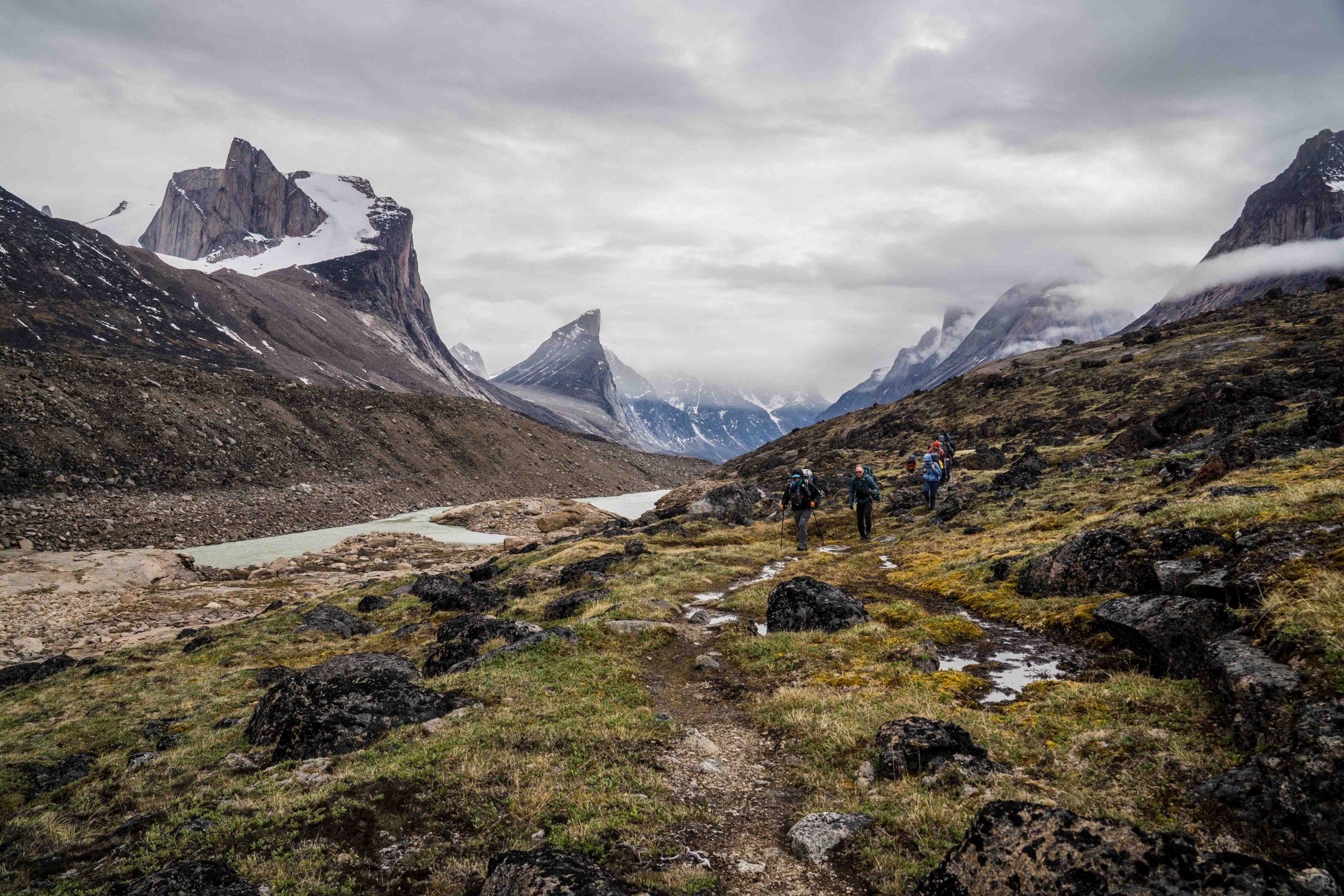
Akshayuk Pass follows a broad glacial valley through Auyuittuq National Park, but there is no consistently marked or maintained hiking path underfoot. Parks Canada describes it as an unmarked route through braided rivers, lakes and mountains, which means you’re navigating through the landscape rather than following a defined trail from point A to point B.
In some sections, the way forward feels really obvious. In others, you may be picking your way around rivers, wetlands, rocks or rough terrain to find the best line through the valley. That also explains why the distance you actually hike can end up being quite a bit longer than the official route length.
And honestly, that’s one of the things that makes Akshayuk Pass feel like a true expedition. You have to read the landscape and find your way through it as you go. That’s why people often choose to go with a guide, so they can focus more on the experience while we handle the route finding, river decisions and day-to-day navigation.


Do you need backpacking experience to hike Akshayuk Pass?
Yes, previous multi-day backpacking experience is strongly recommended for Akshayuk Pass.
While our guides manage the route planning, day-to-day group safety, river crossings, weather decisions, and the bigger logistics of travelling to and from (and through) the Auyuittuq National Park, guests still need to be capable and comfortable carrying their own gear, hiking long days over uneven terrain, setting up and breaking down their camp, and looking after themselves in a remote backcountry environment.
What are the river crossings like on Akshayuk Pass?
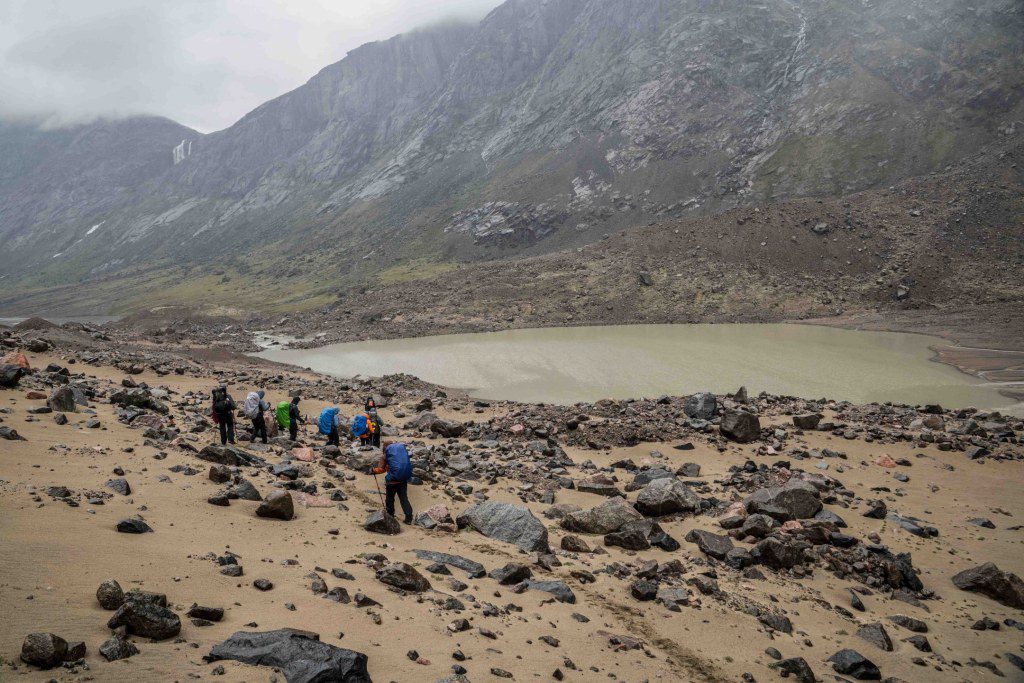
River crossings are one of the biggest challenges of hiking Akshayuk Pass. Parks Canada considers them the most significant hazard facing summer visitors in Auyuittuq National Park, mainly because most of the rivers are glacial-fed and the flow volume can change quickly with warmer temperatures and rainfall. A crossing that looks manageable one day, or even one morning, can look completely different a few hours later.
Some crossings are straightforward. Others can be cold, waist-deep and fast-moving, with uneven footing beneath cloudy glacial water. When water levels are high, waiting is sometimes the safest option, even if that means sitting tight for hours or even a few days while levels drop. Some rivers, including Owl River and Half Hour Creek, can require very early starts around 2–3 AM so you can attempt the crossing when water levels are at their lowest.
This is also where travelling with an experienced group makes a big difference. Our guides assess each crossing based on water depth, speed, terrain and the abilities of the group, then decide where, when and how to cross. In stronger currents, we may use group crossing techniques, sometimes in chains of up to 10 people, to provide additional stability and support. And if a river is simply too deep, fast or strong to cross safely, the right decision may be to wait, adjust the route or even turn around.


During our Akshayuk Pass expeditions, river crossings have ranged from easy ankle-deep wades to some of the most serious moments of the trip. In our experience, river crossings are a much more immediate safety concern than polar bear encounters.
When is the best time to hike Akshayuk Pass?
July and August are the main hiking months for Akshayuk Pass, when summer boat access into the park is generally available. But even in the middle of summer, Arctic weather can be unpredictable, and hikers should be prepared for sudden temperature drops, strong winds, rain, and even snow.
The river conditions are another big factor when choosing your dates to complete the hike. Parks Canada notes that high water has historically been most problematic from the last week of July through the first week of August, when warmer temperatures and rainfall can increase glacial runoff and make the river crossings more difficult or even temporarily impassable.
That’s also why we schedule our Akshayuk Pass departures a little later in the summer. It helps us avoid those typical early season conditions when sea ice can still make access to the northern end of the pass difficult, as well as the period that has historically seen the highest river levels. Temperatures are also generally a little milder than at the very beginning or end of summer, although you should still expect cold, wet and changeable Arctic conditions.
As a general note, there really isn’t a perfectly predictable window to complete the trek. The best approach is to choose your dates carefully, build flexibility into your itinerary, and arrive fully prepared for the Arctic to have a few plans of its own.
What is the weather like on Baffin Island in summer?
Summer weather on Baffin Island can change quickly. You might hike for hours under blue skies and warm sunshine, then find yourself layering up and battling cold wind and rain later that same day. Snow is a possibility too, even in the middle of summer.
Parks Canada recommends that summer hikers come prepared for sudden drops in temperature, strong Arctic winds, rain, and snow. On a multi-day trip through Akshayuk Pass, that means packing for a much wider range of conditions and temperatures than typical summer hiking in Canada might suggest.
One thing to keep in mind is that daylight changes quickly later in the summer. By mid to late August, the days are already noticeably shortening, and true night starts to return by the end of the month, bringing colder evening temperatures.
More importantly, your daily schedule is dictated less by daylight and more by river levels, rain, wind and the physical demands of the route. Conditions can force early starts, long waits or changes to the plan, which is why building buffer days into your itinerary is so important for a successful crossing.
In summary, expect a little bit of everything and pack accordingly.


What do I need to bring and carry on an Akshayuk Pass expedition?
Expect to carry all of your own personal gear and food for the duration of the trek. Packing for the Akshayuk Pass is a balance between bringing what you need to stay safe and comfortable, and keeping your pack as light and manageable as possible.
Your personal hiking kit packing list should include:
- A 60–80L hiking backpack
- Hiking clothing and warm layers
- Waterproof shell and pants
- Sleeping bag and sleeping pad
- Lightweight 3-season tent
- Waterproof hiking boots
- Hiking poles
- Sturdy water shoes and neoprene socks for river crossings
- Water bottle or hydration system
- Personal toiletries, medications and other essentials
Good waterproof equipment is especially important here. As we’ve mentioned before, Arctic weather can change quickly, and once you’re in Akshayuk Pass, there’s nowhere to dry out properly or replace something that gets soaked through.
During our Akshayuk Pass expeditions, we provide the dehydrated meals, trail snacks, cooking equipment and other shared expedition gear, but guests have to carry their own food allocation and share of the group equipment throughout the trek.
We ask participants to keep their fully loaded backpack under approximately 18 kg / 40 lb. Around 6 kg / 13 lb of that will typically be food, leaving roughly 11 kg for your clothing, sleeping system and other personal gear.
Once you complete your booking with us, we’ll send you a detailed packing list so you know exactly what to bring.

Where do you sleep while hiking Akshayuk Pass?
Akshayuk Pass is a tent-based hiking expedition from start to finish. Each night, you’ll need to set up your camp somewhere along the route and sleep in your own expedition tent, surrounded by some pretty spectacular Arctic scenery.
Because the pass can be exposed and windy, securing your tent properly is an important part of camp setup. Rocks can be used to help anchor tents where appropriate, but Parks Canada asks visitors not to build rock windbreaks and to return any rocks used to their original location before leaving camp.

There are nine emergency shelters along the pass, spaced about one day’s travel apart, with outhouses nearby. These shelters are strictly for emergencies and are not intended for regular overnight accommodation.
The outhouses are simple barrel-style latrines used during the summer season. Human waste goes into the barrels, which are removed later, but everything else needs to be packed out. Toilet paper should either go into the latrine barrels or be burned only where it is permitted and safe to do so.
Outside of those shelters and outhouses, there are no campgrounds or staffed facilities or any other services along the entire route.
If you’re familiar with hut-to-hut hiking, like our Hidden Trails of Iceland hiking expedition, the Akshayuk Pass is a very different style of trip. You carry what you need, you choose suitable places to camp, and you settle in to wherever the day takes you.
But that self-sufficiency aspect is a big part of what makes Akshayuk Pass trek feel so rewarding. By the end of the expedition, you’ll feel a real sense of accomplishment in knowing you made it through the remote Arctic wilderness under your own skill and power.
How do you get to the Akshayuk Pass trailhead?
During the summer hiking season, Akshayuk Pass is accessed by boat from either the north or south end. The route can be hiked in either direction, with access from Qikiqtarjuaq in the north or Pangnirtung in the south.
To reach either community, you first need to fly through Iqaluit, the capital of Nunavut. Most independent travellers use scheduled flights with Canadian North Airlines.
On our guided Baffin Island hiking expeditions, we hike the Akshayuk Pass from north to south. The group meets in Iqaluit and then flies together by private charter to Qikiqtarjuaq. We choose to charter our own aircraft rather than rely on scheduled commercial flights because weather-related cancellations are very common in the Arctic, and rebooking a full group can sometimes lead to long delays. Having a dedicated charter gives us more flexibility to work around weather windows and helps reduce delays getting the group into Qikiqtarjuaq.
Once in Qikiqtarjuaq, we complete the required Parks Canada orientation and registration, then travel roughly 80 km by boat (about a 2-2.5 hour boat ride) through North Pangnirtung Fjord to the northern end of the route.
From there, we begin the trek south through Akshayuk Pass and finish on the Pangnirtung side.


The logistics take a bit of planning, but they’re all manageable with the right preparation. If you join one of our guided expeditions, we coordinate the major travel and access logistics so you can focus on getting ready for the trek itself.
Where does the Akshayuk Pass hike finish?
If you plan to hike the Akshayuk Pass from north to south, then your trek will finish at the southern end of the route along Pangnirtung Fiord. From there, you walk roughly 4 km past the Ulu emergency shelter to the boat pickup point, then take about a one-hour boat ride back to Pangnirtung.
Pickup needs to be coordinated with the local outfitter based on tides and weather, usually using a satellite phone or messaging device. Once you’re back in Pangnirtung, you also need to de-register with the park rangers so they know you’ve safely completed the route.
Vice versa, if you plan to hike Akshayuk Pass from south to north, your trek will finish at the northern end of the route along North Pangnirtung Fiord, followed by a boat transfer back to Qikiqtarjuaq and the same requirement to de-register when you finish.
On our guided expeditions, we finish in Pangnirtung and take care of the pickup coordination and required park procedures for the group. We also include a one night stay at a hotel in town at the end, so the group can have a proper shower and one final dinner together, before flying back to Iqaluit the next day by chartered Twin Otter to help reduce the risk of travel disruptions.
Will you see Thor Peak and Mount Asgard on the hike?
Thor Peak and Mount Asgard are two of the most recognizable landmarks along Akshayuk Pass, and both are visible from the route when conditions cooperate. Parks Canada specifically references Thor and Asgard among the major peaks that “will guide you through this spectacular landscape.”
On our guided expeditions through Akshayuk Pass, we don’t climb either mountain as part of the trek, but we move through the valleys beneath them and have opportunities for some pretty incredible views along the way. Our groups have also enjoyed views of Mount Loki, Mount Odin, Mount Breidablik, Tirokwa Peak and other peaks throughout the pass.
That said, Arctic weather is unpredictable, and clear views are never guaranteed. Low cloud, rain or fog can completely hide the peaks, sometimes for hours or even days.
When the clouds do lift, though, the views of Thor and Asgard are absolutely incredible.

Are there polar bears in Auyuittuq National Park?
Yes. Polar bears can be encountered anywhere in Auyuittuq National Park, although Parks Canada notes that Polar bears are most active in and along the Davis Strait coast. The possibility of an encounter still exists year-round, so travelling through the park means taking polar bear safety seriously.
All visitors are required to complete a mandatory Parks Canada orientation before entering the park, which covers current conditions and important safety information. Parks Canada also recommends travelling in groups, staying alert for signs of bear activity and following existing campsite and food-storage practices.
On our guided Akshayuk Pass expeditions, polar bear safety is built into how we travel and camp throughout the trip. Our guides follow the established polar bear safety protocols, monitor the surrounding landscape, carry polar bear deterrents, and build wildlife safety into how we travel, camp and store food.
Fun fact, in 2026, there was a polar bear moving through the area while we were backpacking the pass. We never saw it, but we were travelling through the same landscape at the same time.
Should you hike Akshayuk Pass independently or with a guide?
That really comes down to your experience level and how much of the expedition planning you want to manage yourself.
Experienced Arctic backcountry travellers can hike Akshayuk Pass independently, but we’d recommend having strong multi-day backpacking experience, confidence navigating unmarked terrain, and a solid understanding of river crossings, remote travel and emergency planning before taking this trek on without an experienced guide.
On the other hand, joining a guided expedition removes most of these logistics from your plate. That includes access planning, permits and registration, day-to-day navigation, river-crossing decisions, local transportation, group safety, emergency management and the broader expedition planning that comes with travelling through such a remote part of the Arctic.
Neither option is inherently better than the other. If you have the experience and want the added challenge of planning the trip yourself, independent travel may be a great fit for you! But if you’d rather focus on the hiking and experience while someone else manages the logistics and safety decisions, a guided expedition can make the trip much more straightforward.
Thinking about joining this expedition next year? Learn more and join the interest list here.
This trek isn’t for everyone. But for those ready to embrace the true remoteness of the Canadian Arctic, Baffin Island offers an adventure as wild as it is humbling.